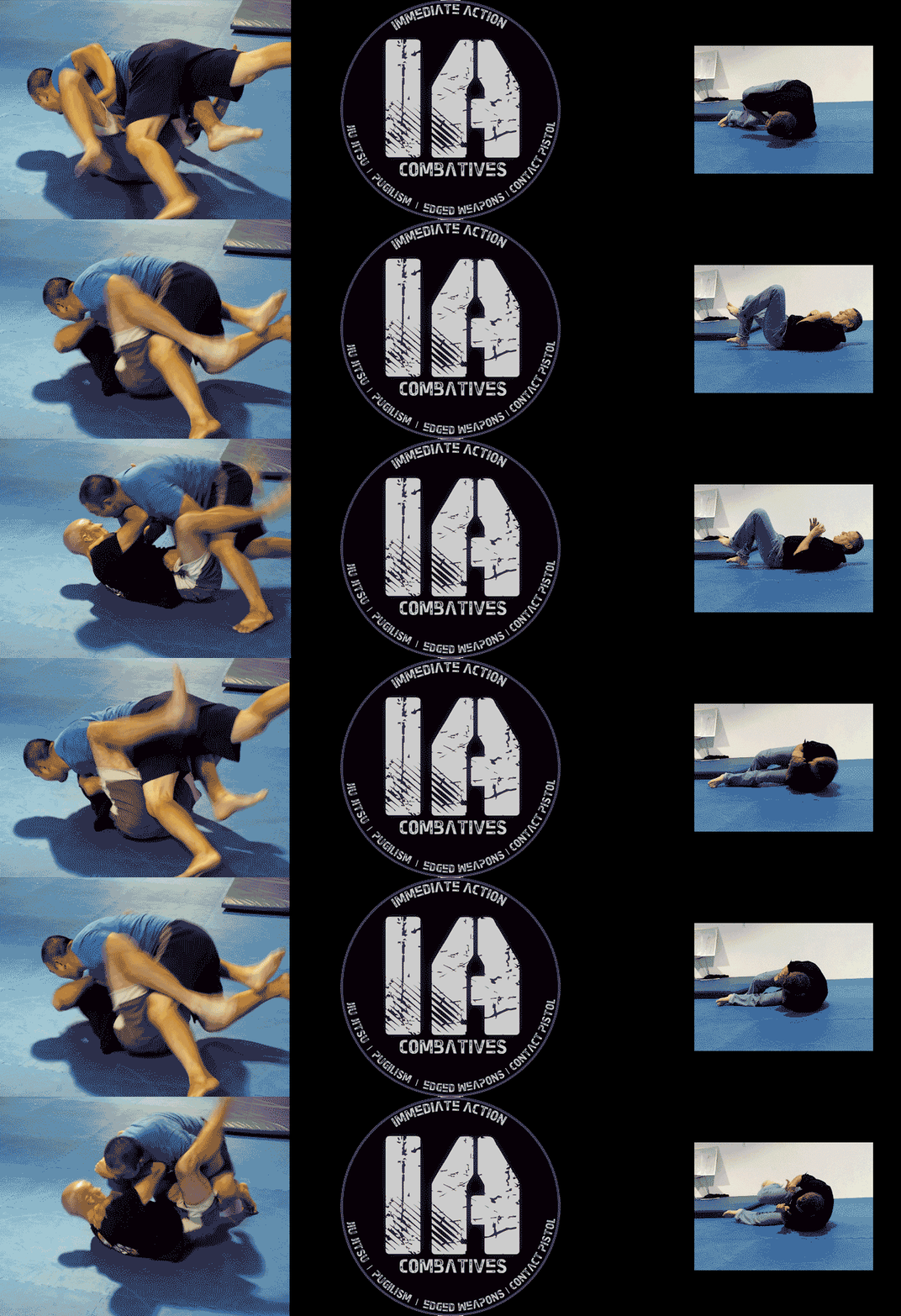
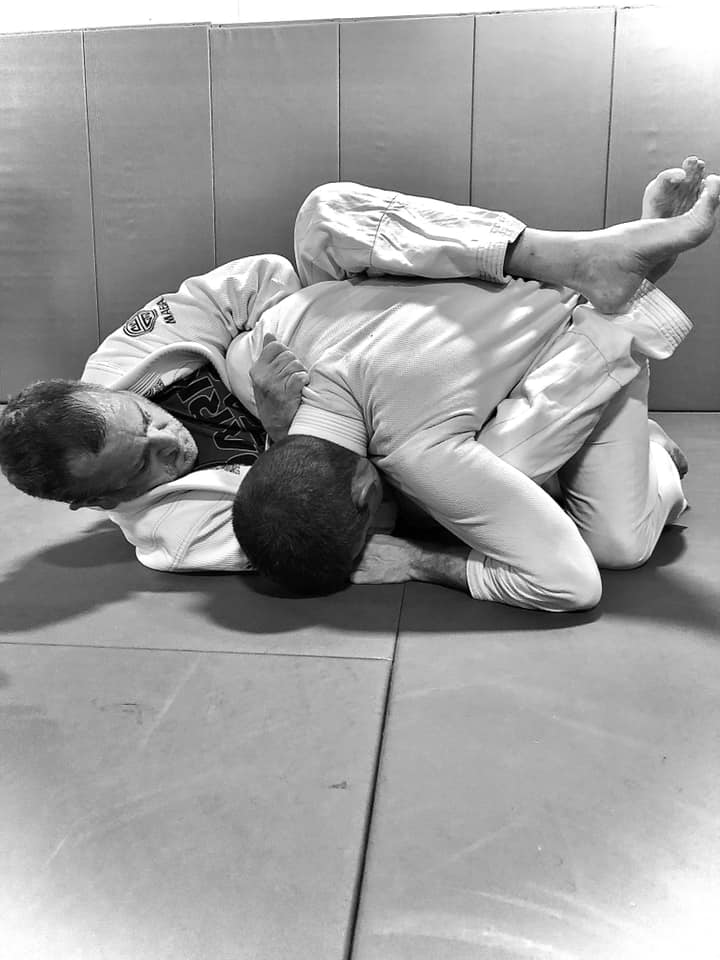
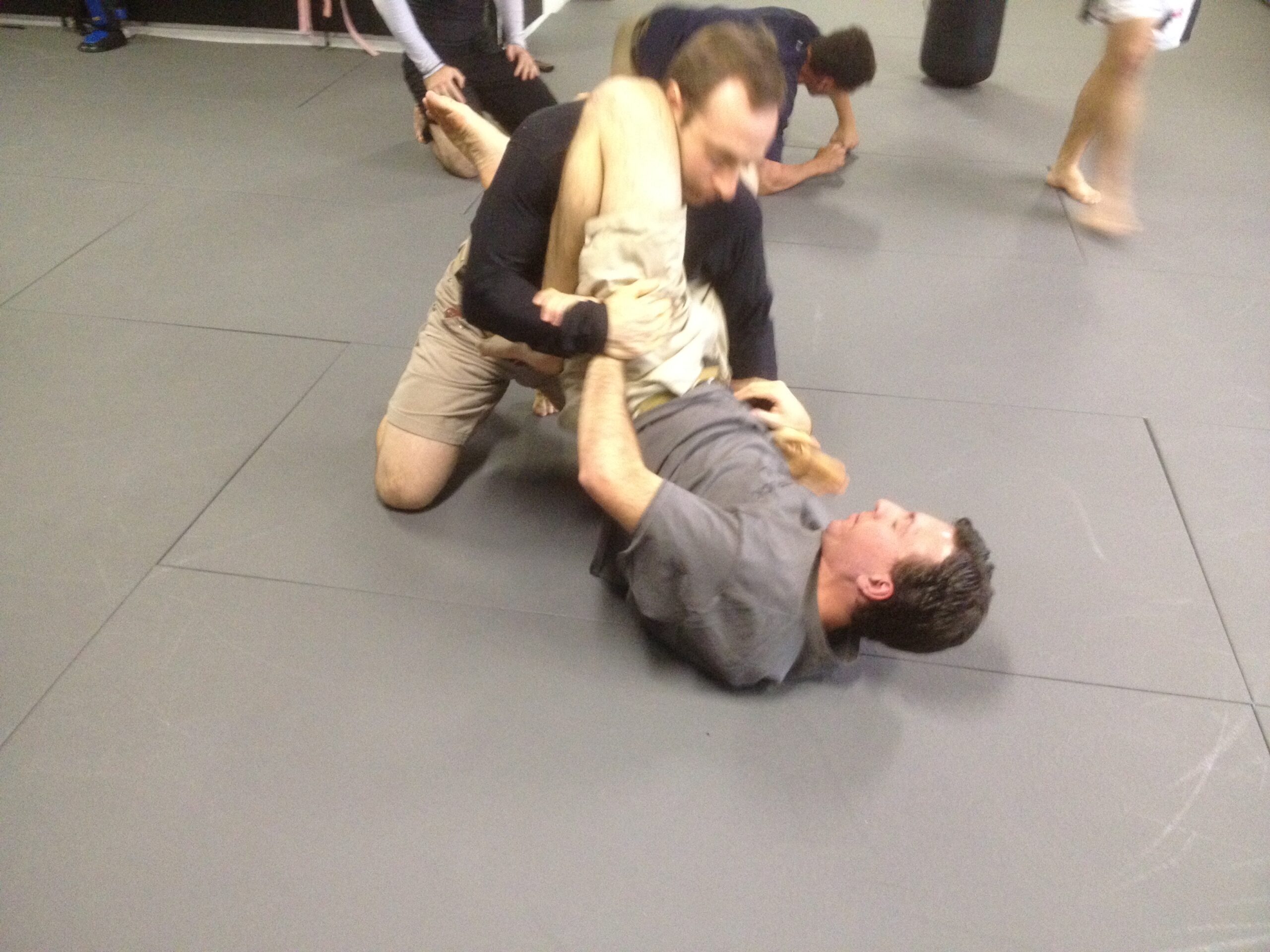
I have written a lot, and for quite literally decades, about my personal training journey. One of the reasons I do so is to show others that not every day is a champion level day. Nor is the journey easy or light. We all struggle constantly. I also share my failures (and anyone who has followed me for long know there are a buttload of those!) to show people that just because someone has accomplished something and has skill in an area or areas, it does not mean they started that way. The greatest champion has had to work for it, and has met many failures along the path.
I think I have a responsibility that goes along with having a public voice that some people will listen to, that I need to be as encouraging as possible to those filling the same path behind me.
The truth is that there are a lot of days all of us don’t feel like training.
Whether that is getting on the jiu-jitsu mats, lifting that barbell, putting on the running shoes and HR monitor, or going through the motions to get set up for a dry fire session, there are times when life has beat us down and we would prefer to lie in bed and pull the covers over our head.
Sure, we have the image in our head of that super bad ass that is always pushing the iron while running marathons and ragdolling people on the mats and shooting a 5 second FAST test who is impervious to outside influences, but that is a fantasy. Life gets in the way for all of us and there are going to be the times we just don’t want to train.
For example, a few weeks ago, I did not want to roll.. A long trip on the weekend with little sleep, and some personal/family medical issues drained me about as much as a person can be drained without withering away. And to be honest, being 61 on jiujitsu mats facing guys who are 25, 30, and even 35 years younger than you is daunting at times. The easy thing to so would have been to miss the rolls. And I pondered it for a short time on the drive there. In the end I went, and in the end I did roll.
Did I do great? NOT ON YOUR LIFE. But that is not the point. Training is the Way, not being the dominant guy. It is not about the new squat PR, not about tapping everyone in class, not about getting the cold, on demand sub second draw. What it is about is just doing it. Even if “it” is just doing a single set of 10 goblet squats with a 35lb kettlebell, or doing 10 standing up in base, or doing 10 dry fire draws from concealment.
Don’t get wrapped around the axle that we are always awesome. The majority of the time we are going to feel “meh”, and perform as such. Who cares? Enjoy the process. The goal will take care of itself.
I wrote recently about the preference for the term self preservation over self-defense. Self-Preservation is far more overarching and applicable, and as I wrote in that article, it is very multifaceted with many aspects to cover.
While the easily understood things like firearms usage, Empty hand skills, Knife methods, OC spray, etc., are all needed, we also need to look at our financial health, Mental and emotional health and stability, our relationships with others, proper vehicle maintenance and defensive driving, as well as medical and dental needs. All of these things are a must to live a happy and productive life, with longevity and the ability to enjoy that longevity.
Of all the different components of Self-Preservation, I would strongly argue that Pre-Fight Threat Containment is the most important area we can work on, and the one most needed to keep us safe. This can cover things like De-escalation, verbal judo, managing unknown contacts, Situational awareness, understanding how violent criminal acts think and act, and having a mindset that understands reality of the world, as well as a determination of how we will conduct ourselves as needed (are we willing to use force – up to lethal – to defend ourselves?).
And if Pre-Fight Threat Containment as a whole category is the most functional (and it is), then the most critical part is what is called Deselection. It is a term that gets thrown around a lot in the training community, but tends to be very nebulous. What exactly is covered by this term, and how do we use it?
Essentially, at its core, Deselection means that bad guys view you as not a good choice to victimize. They look at you and decide to look elsewhere for a victim. It is not necessarily that you need to look like some Apex Predator. That is not realistic for 99% of the population, and even if you are in the 1%, there are always more Apex Predators. It is not a singular thing so it alone does not ensure safety.
The late, great William Aprill lectured on how bad guys have a very binary decision making tree. They look at a potential victim and if they think “yes”, it’s on. But if they don’t have a positive “yes”, then it is a hard “no. They don’t think “maybe”. If it is not obviously yes, then it’s a no-go. So for us, all we need is not to be a hard “yes”.
Fortunately for us, thanks to decades of scientific research, we know what a hard “yes” looks like.
The seminal and groundbreaking study “Attracting Assault: Victim’s Non Verbal Cues” by Betty Grayson and Morris Stein from 1981 gives us what we need most. They discovered exactly what criminal predators look for in a good victim. Things like awkward movements while walking, poor posture, odd gait, head and eyes downcast (consciously as well as through poor posture), etc gave off strong signals to bad guys.
This information leads us to the single best way to get ourselves deselected, in an inarguable and scientifically driven way. Having a modicum of physical fitness will strongly push us into being deselected. Period. Read the above victim cues. They all are antithetical to having some fitness. When you are out of shape – too fat, too skinny, too heart or lung weak – all of the above characteristics will be you. They are an inevitable outgrowth of a poor level of fitness. On the other hand, when you have a reasonable level of bodyfat, have a little bit of muscle, heart, and lung strength, you will exhibit the exact opposite of the “victim traits”. Your posture automatically improves, you will have a steady and purposefully gait, and it will be almost subconscious to have your head up and eyes looking around at the world in front of you. Criminals may not look at you as some kind of dangerous predator, but they will not see prey.
And no other aspect of a multi-disciplinary self-preservation skillset will give so much of the benefits of deselection as health and vitality will. Carrying that concealed handgun won’t in and of itself, and carrying openly will more likely make you a target rather than get you deselected.
And this is not about walking around with 5% bodyfat, squatting 300lbs, being able to run a 10k. Those are for sure great examples of a great level of fitness, but we don’t need that. Remember the criminal binary decision tree. We just need to not be an obvious “yes”.
This crucial concept is what is missed by all those voices online that desperately try to minimize how useful and important health and vitality is for Self-Preservation. They will use infantile Straw Man arguments and say things such as “people get through life and death encounters without fitness”, as if that means it is a good idea. Millions of people also survive violence without a gun. Does that mean the same anti-fitness people think we have no need to carry a gun to help defend ourselves? There are people who have fallen out of airplanes from hundreds of feet up and have survived. It does not mean that is something that should be striven for….
But most importantly, I DON”T WANT TO HAVE TO BE IN A LIFE AND DEATH FIGHT. Regardless of whatever skill level and capability I possess, or whatever amount of tools I carry on my person on a daily basis, I prefer to only exercise those skills in the training environment. If I can keep from being ever involved by a criminal because they have deselected me simply due to the fact that I exhibit a tiny level of health and vitality as I walk down the street, then right there that fitness (at whatever level) has saved me from potential death or grave bodily harm, and has kept me from having to endure the post fight legal battle. All simply because I took a little time away from shooting, and spent it doing health and vitality training.
I don’t know how anyone could say that was not about as effective a self-defense tactic as there has ever been.
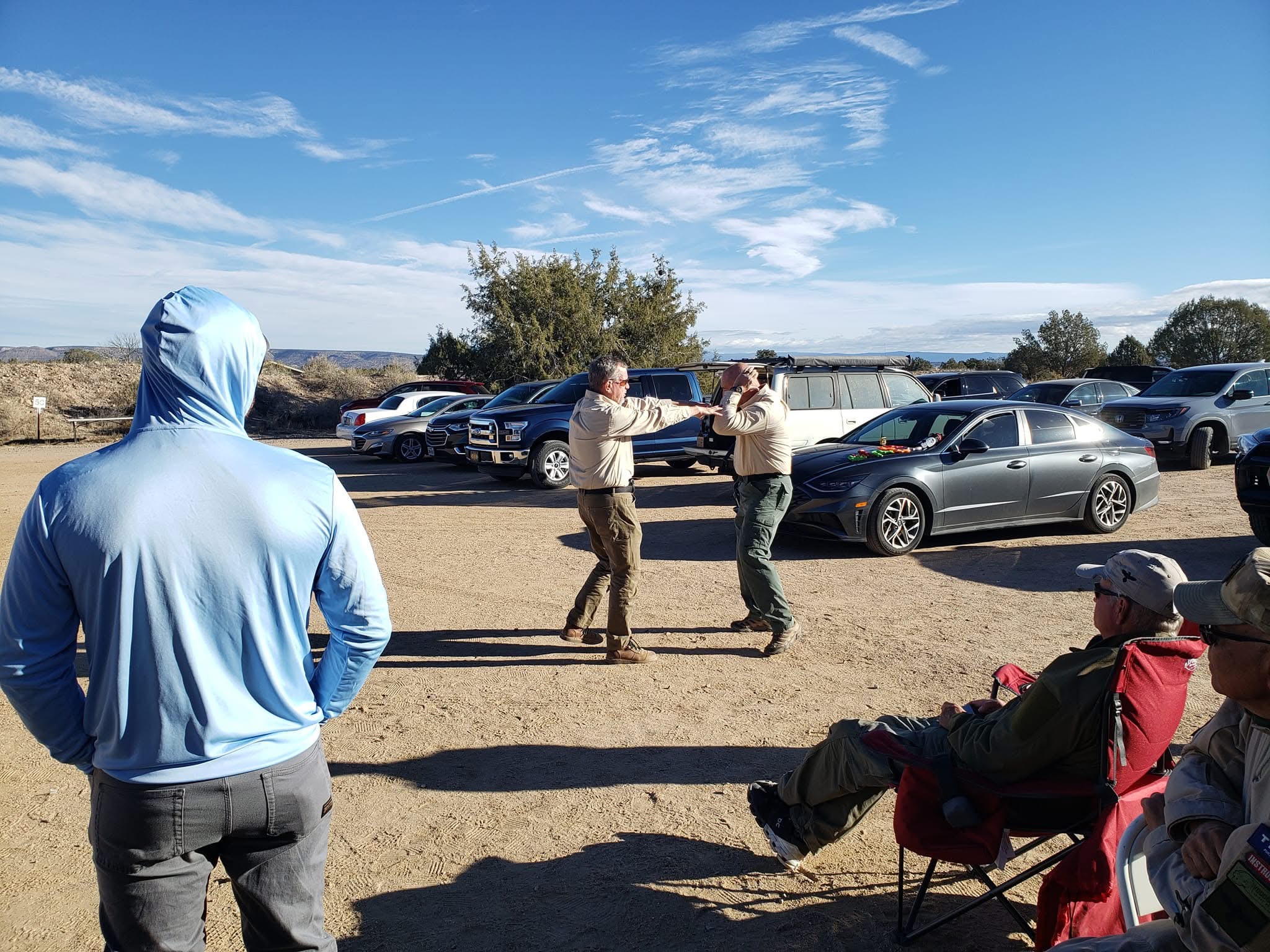
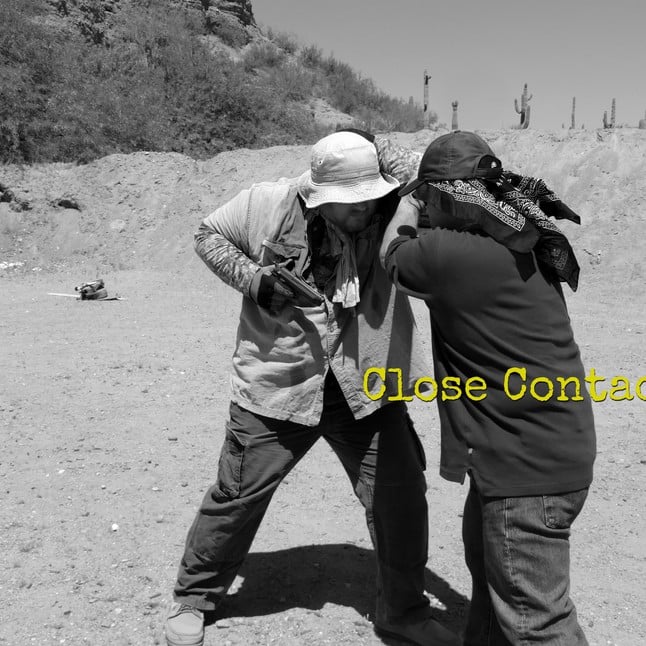
After a couple of years of focusing on being a full time caregiver, I am easing my way back to doing seminars again. On January 24-25, 2026 I will be doing a somewhat rare in-town seminar at the Casa Grande Police Range. In connection with Independence Training, we will be teaching Close Contact Handgun coursework to give people a safe but realistic understanding of the complicated matter of gaining and maintaining space to use a handgun effectively, but even more importantly how to use movement, awareness, and verbal dexterity to ideally not even get into a violent encounter in the first place.
This is the fundamental base where we try to ensure that we don’t end up in an entanglement, and we can use our handgun to maximum effect. There is some VERY MINOR physical contact in the class with little to no impact, but it is extremely limited, making the course suitable for anyone who is looking to get their feet wet in the close range self-defense envelope. This is a great introduction to the 0-5 yds gunfighting envelope for those who have been hesitant to do so from lack of physical conditioning or little experience in H2H fighting , and has the thumbs up for Craig Douglas of Shivworks (since we shamelessly are teaching a great deal of his material in the course). We have had some great feedback results when we taught this course before, including people who have taken ECQC. We are looking forward to doing it again.
In this class we will look at ways to maintain distance, using verbalization, footwork, positioning, and awareness to keep distance from an aggressive criminal, and to utilize the pistol in a manner in which we can prevent him from stopping us. The focus is on NOT getting entangled and having to get into a physical fight, but rather to use the pistol the way it is intended to be used – at a distance.
We will cover:
Maintaining Spatial Relationship
Functional Footwork
Proper Verbalization
Presenting the pistol through an appropriate line of extension and compression
Live fire through extension and compression
Retention Shooting (both from the thumb-pectoral and the compressed high ready)
Live fire retention shooting
Integrating Verbals with everything else
Recognizing when it is appropriate to go to the gun and when not to
We will be working live fire on the range, as well as drilling concepts with blue guns. At the end we will pressure test our new skills in mild and no-contact Force-on-force scenarios against resisting opponents with opposing will and freedom of action using airsoft. We will be working in open space, in and around vehicles, and inside structures.
Students will need a suitable carry pistol, at least three spare magazines, a quality holster, and 150 rounds of ammo. If you have training guns and training knives, please feel free to bring them.
A man broke into a home after midnight, and attacked a man and wife. He stabbed the woman to death and was stabbing the man, who continued to fight throughout the house for an extended time, until they broke into the front yard, and the homeowner was able to get to his car and retrieve a gun from the vehicle and shot the murderer to death.
So what are the takeaways?
First, I don’t want to hear anyone say “I would have shot him before it went entangled”. No you would not because you don’t sleep with your gun on your hip, and even if you did, being woken up in the middle of the night to find someone stabbing your wife of 30 years to death in your bed would blow the brain circuits for a few moments. The bad guy would be on you long before you got your gun into play. There is no sub second draw in your bed when you are sound asleep.
Secondly, not only does this incident serve as yet one more shining example of how private citizens face grappling with weapon situations all the time, it also gives the lie to those who love to try to say that physical fitness has no role in self-defense. How much did an extended fight like this, that started with a massive shocked adrenaline dump of seeing your wife being stabbed to death, in your own bed, from a deep sleep, and then fighting a younger guy for minutes as you move through your house? Do you think he thought “hey, that was easy. I don’t even feel that”? Do you have to be in decent shape to survive a life or death struggle? Of course not, but has anyone ever said after “My heart and lungs didn’t even register what happened”? So ridiculous to dismiss health and vitality in a self-preservation context.
🚨Breaking News Thanking Our Community Heroes at the Alaska State Fair
Yesterday at the Alaska State Fair, we were reminded of the power of community and vigilance. A good Samaritan stepped up, potentially preventing a dangerous situation from escalating.
The incident from this video just happened in the past few days and shows a great example of an entangled fight only involving private citizens (no LE presence at all) and weapons being produced.
What are the takeaways we should focus on?
That it happened at all.
The fight was already on and the people involved were already entangled when one of them attempted to produce a handgun (of the two that he was carrying). We must remember that just because it starts with empty hands and blows being thrown does not mean it will continue on that path. We cannot assume what goes on in the head of other people.
The person trying to get the pistol into the fight had zero control of the entanglement. He did not have a good position in relation to the other person (and I would like other video commentators who have little to no actual grappling experience to try to explain why he was not in an optimal position. They won’t be able to because they don’t know. Please don’t listen to non-grapplers who pretend to be SMEs in grappling). He also failed to control the arms of his opponent, who then had complete freedom to counter as he saw fit. Letting the other person have that freedom puts the odds of being successful at your in-fight weapon access (IFWA to use Craig Douglas’ terminology) at about 50/50. It may still work, but there is an equal to greater chance it won’t. So you better have a bit of training and practice in understanding the entangled fight. And no, having years doing a traditional martial art that spends 99.9% of it’s time working stand up, ranged striking gives you no grasp at all of grappling.
A lot of people fail to understand the above point about having arm control. They see those of us who do teach this sometimes teach bringing a weapon into play when you don’t have arm control, such as when you are underneath a bigger, stronger opponent – perhaps even face down – and you access a fixed bladed knife carried centerline on the belt. I have heard some non-experts try to say “see! You don’t need arm control! They are hypocrites in their teaching!” What these people fail to understand is that drawing a blade when you are on the bottom and pinned down is a worst case scenario. You have no other workable alternatives, and trying to get a blade out that was carried in an optimal position at least gives you a chance. But none of us who teach this material wil lever say it is unstoppable. It is easily stoppable by someone with just a little knowledge. In that scenario, we have no control over the bad guy and he is free to counter our knife draw. But that is the only chance we have. It is better to roll the dice and try instead of accepting death. But it is not optimal. People who have little training should refrain from publicly commenting on these things until they truly understand what it is they are saying.
The other interesting take on this video is that almost always we view other unknown actors around as bad guys too. We never take into account that they may be good guys and can help. Certainly we should not count on it, but neither should we completely dismiss the possibility of others around being positive.