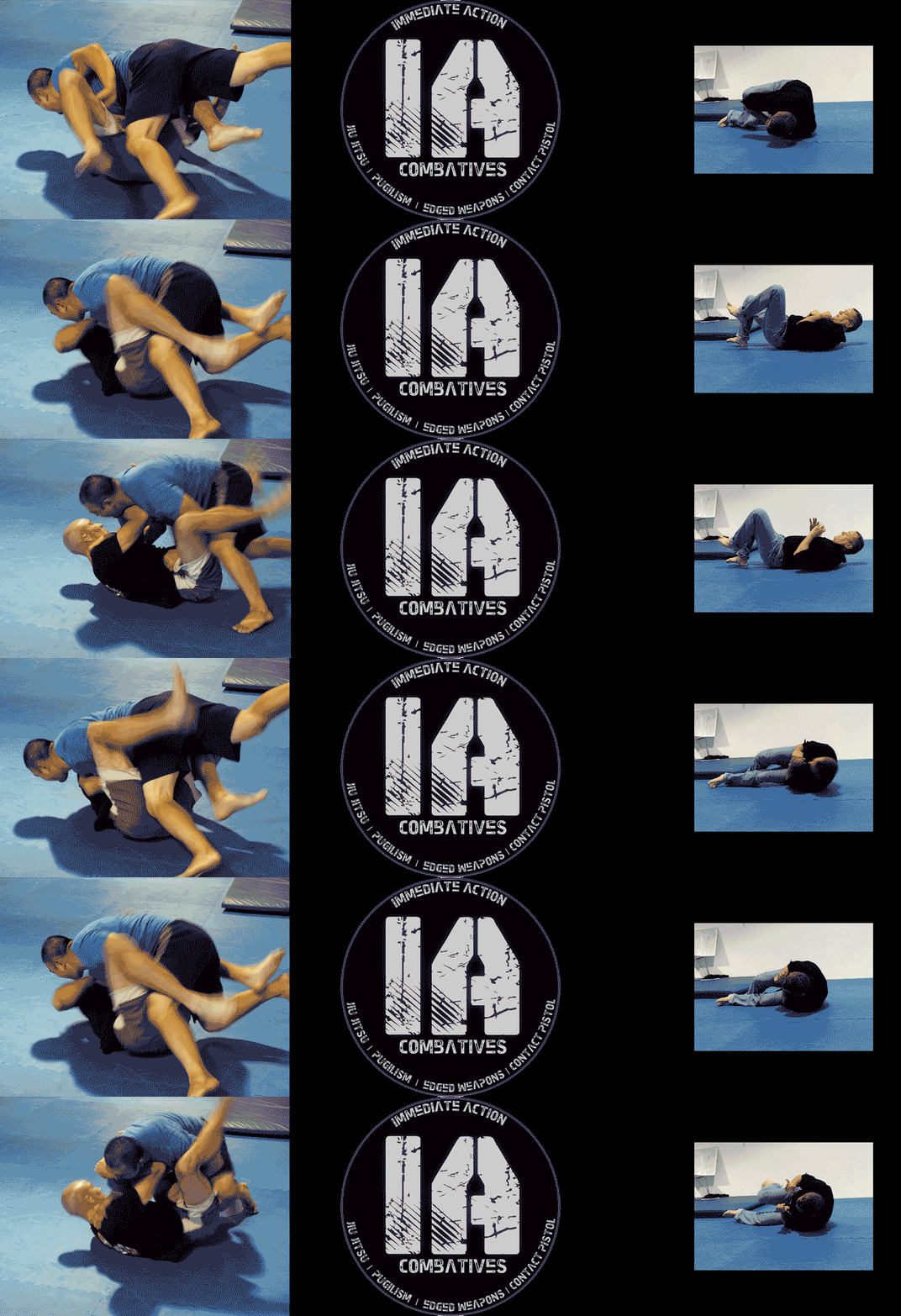
Here is a link to a nice article about my teammate (who also happens to be my coach’s daughter) and it has some funny (and true stories about my coach). One day I will write a post about the old days of training with Megaton. As soon as the therapy helps me deal with it, that is!
The following is an AAR of a course I co-hosted recently in Northern AZ, ECQC run by my friend and one of my mentors, Craig Douglas. There are some really insightful comments by the writer, Jason. BTW, he is a really good dude who makes some solid kydex holsters and he stands by them 100% . He is going to make me a pistol mag carrier that is perfect for the ECQC environment(for info on pricing and availability, as well as custom work, contact him at : info@tcbfirearms.com
ShivWorks ECQC 04/19/2013-04/21/2013
http://shivworks.com/
Flagstaff, Arizona
Hosted by Independence Training
http://www.independencetraining.com/
http://shivworks.com/
Flagstaff, Arizona
Hosted by Independence Training
http://www.independencetraining.com/
Day 1- 04/19/2013 4 hours
Meet and intro. If you do not know of Craig and his history he is a former LEO with heavy Undercover and high impact/high risk work. We then went around the room and each gave a brief “who we are and what we hope from the class” intro.
Explanation of the reasons behind the course and the “why” of several of the techniques.
MUC- Managing Unknown Contacts
· Verbal
· Movement
· Hands
Basically a “how to” develop your own system of what do you say, how do you move, and what you do with your hands.
We did some drills with an encroaching individual. Several teaching moments developed out of this for us to learn as a group from individual actions.
Non-Compliance-
If it cannot be handled verbally and with movement…consider initiating contact.
· Position, Posture, Pressure
· Drill of the eye strike
· Drill of “default position”
· Drill of “posture”- First Blood of the class from the “Mountain Goat” Drill
Indicators- Things people do before striking. (Amazingly when you look for this it is VERY evident and easy to predict) We drilled on this trying to spot the cues during MUC.
· Grooming
· Loading
· Picking
· Target Look
2 Goals of MUC- Stay Conscious, Stay Mobile
End of Class
Day 2- 04/20/2013 8 Hours
Safety brief including expectations and assignments.
· Baseline- We all shot on demand for the instructors to see and evaluate everyone’s current technique and skill base.
· Draw stroke. Craig teaches a 4 position similar to what most any shooter will be familiar with. The difference is the use of tactile positioning throughout the draw.
· Shooting from the 2 (second position). Think of using a high tang grip with thumb extended. Indexing your thumb, gun and hand on your pectoral. This is very effective and consistent
· Lunch- After lunch ALL weapons removed and verified. Sim guns and safety gear brought out. Safety brief and limits, expectations laid out.
· Some basic grappling and control techniques we had discussed the previous day are reviewed and practiced. (Always rotating to new partners)
· Basic movement and shooting from the ground practiced.
· Drill 1 on 1- Person one is armed and on the deck, person 2 is standing. On command fight until told to stop.* Reverse positions and repeat. Everyone participated.
End of Class
After clean-up we went out to dinner as a group. Good times with good stories. To try and give an idea of the impact of all this…I spent about 30 minutes trying to find a way to get out of the next day. Not out of fear or injury per se, but I so far had to question and apply almost every lesson I had learned in my life about weapons and violence (along with my own gut-check) and I had major doubts in myself. Thankfully between realizing this opportunity was too good to pass for any reason (real or imagined) and the next morning I was ready to go for the final day.
Day 3- 0/21/2013 8.5 hours
· Back on the firing line. Working shooting through all positions while utilizing defensive use of support hand or movement.
· Draw and shooting from non-standard positions and/or environments. The drills were all challenging mentally as application in the real world is stressed throughout this course. (My motivation was not “My training buddy/target is doing x”, but a mindset of “someone is coming to hurt or take my family.” The stress was as real as simulation can make it .)
· Final Shooting Drill.- Put all live fire drills together into one.
· Lunch- After lunch ALL weapons removed and verified again. Sim guns and safety gear brought out.
· Additional grappling/ground movements covered.
· Drill 2 on 1- Person 1 is armed, person 2 is not. Person 1 has to MUC, with an additional Person 3 (unarmed) entering into the drill at a random time. This is “role-playing” intensive with no script or teams. Some of it was funny, intense and some downright scary. Each person rotated through each position in the drill.
· Weapons retention lecture and drill. How do you maintain control of your weapon, or take theirs was covered. Again drill and rotate to a new training partner.
· Drill 1 on 1- Both armed guns drawn. Person 1 on ground, person 2 kneeling over in a side posture. You have the grip of your gun in your strong hand and the slide of your opponent’s gun in your support hand. On command fight until told to stop. Reverse positions and repeat. Everyone participated.
End of Instruction.
Range clean up.
Informal AAR from each student and instructors.
End of Class
My personal take on the ECQC Class.
Anyone who carries a gun regularly, for personal or professional reasons, should take this class. I am an advocate of training in general, but Craig’s take and class components will force you to at least re-evaluate if not question and change a lot of what you think you know. The class is very well laid out and staged in a way that you build off each lesson/drill and it becomes noticeable and valuable as each stage progresses. While there is no “one thing” I learned, and no epiphany that re-writes personal defense. There are many little lessons I learned however. Some lessons were about technique or position, some about gear or how you carry that gear; most of all the class was about me. This class will teach you more about your actual skillset and mindset than any other I have seen. This is not a “beginning” class, and after taking it I can say it is definitely not a final class. I was extremely lucky to be in this particular class, everyone that was there had a singular goal…to improve. Everyone to a man overcame something, and we all learned several things. Some of what I took away:
· Zombieland was right- “Cardio, Cardio, Cardio”
· The “Total Carry System” works outside of theory. (https://www.facebook.com/notes/tcb-fire … 4488446038 )
· If you say I can’t, you’re right. Hard work is worth every part of it.
· Train multiple techniques, the world is full of variable situations.
The experience is summarized best by quoting Craig’s closing lesson-
“Training should be bloodless battles, and battles should be bloody training”- Roman Proverb
This class, and several of those in attendance, has changed my life…for the better. I am humbled and honored to have been a part of it.
*This was a personal high/low point for me. I have been in fights both competitive and “street” before. I do not know if it was the helmet, my imagination or what…but I panicked. Tried to work through this and failed a second time. This was handled professionally and as an instructional point which really impressed me. Later in the class I can only assume Craig noticed this was wearing on me, as we had an odd number of participants I was called in for another round. Somehow hew either knew before I did I had worked through it, or that I would. While my focus was not on “winning” but simply completing the match I was able to overcome both failure and panic. The encouragement and opportunity to overcome was worth the class fees and time alone.
Brazilian Jiu-jitsu in the Real World
So here is a factual story about a woman using Jiu-jitsu to save her life. Even though there are a lot of Self-defense trainers who still try to convince people that Jiu-jitsu is nothing but a sport and has no value in the street.
I would like to ask these experts what alternative would they have suggested that would reliably work in this situation – i.e. a woman in a foreign country without backup, and unable to carry any kind of weapon, trapped in an enclosed environment against a bigger, stronger attacker? Because her solution worked pretty damned good.
video clip – hip escape
Here is a clip of the other key fundamental jiu-jitsu movement, the hips escape:
video clip – hip bridge
Here is a clip going over one of the two key movements, the hip bridge, or upa:
Video Clip – Survival Position
The following clip is the foundation of not just the IAC course work, but it is also the conceptual lynchpin of everything I teach. I hope you enjoy:
Another BJJ Pet Peeve
Today I want to talk about one of the things that bug me in BJJ. In this case, it is the guy who is so afraid to lose, that he spends all of his energy on holding on for dear life.
You know the type. The guy who hugs your neck with a death grip so you can’t posture up to begin passing his guard. Or the guy who clamps on to you inside your guard with no attempt at passing, just trying to not get swept or submitted.
Listen to a piece of advice from an old and broken, but experienced, BJJ practitioner. Unless you are a super athlete like Michael Jordan who is magic with any physical action you do, or someone who is able to train on the mat 8 hours a day, 7 days a week; what causes growth in your performance is LOSING! Nothing on Earth shows you the path to improvement or how to overcome your mistakes by actually experiencing failure. Every session on the mat should provide you with the clues you need to get better. You only get that by opening up and trying something. You might fail at it, but that is fine. Remember why you failed, and try to fix it.
There is no magic moment where a perfect move will suddenly appear, unless YOU have made it appear.
I have seen a lot of guys on the mat. The bottom line with those everyday guys (not the super athlete or the guy who is able to do nothing but train, but those of us who have to deal with the real world) who improve is that they ALL experienced failure, but kept plugging away and kept trying stuff that failed. That other guy who never opens himself up? Yeah, he gets to say “oh, so-and-so didn’t tap me” but he also never figures out why he is a blue belt after 4 years.
Don’t be that way. Ditch the ego, try to accomplish a positive goal on the mat, and have a light heart. BJJ is fun. Let it be so.
A Pet Peeve of mine involving BJJ
Okay, so here is something that ticks me off involving BJJ.
Why does everyone who watches one UFC think he knows everything about BJJ? Or, why does anyone who has seen a BJJ DVD, or taken a seminar, or surfs the ‘net, thinks they have seen and experienced EVERYTHING there is in BJJ, and can make absolute pronouncements?
Let me tell you, I have been doing BJJ for a while now, and I have been fortunate to have constant contact with a world class coach, as well as have had the good fortune of training in a number of gyms with other great coaches. I also have the good fortune to have a couple of close friends who are as experienced whose brains I get to pick. And with all that, I am still learning new aspects of BJJ. There are so many things I “knew” as a blue belt that I know now was wrong. Just last night, I learned a variation on a Brabo choke that explained why I was only having about a 30% percent success rate with Brabos. Even great players like my coach Megaton, or Royler Gracie never says “this is the fact about this”. They, with all their knowledge and experience will say this is what they think, but never make it dogma.
And yet, keyboard warriors seem to have no problem saying the opposite “This is the way it is, no ifs, ands, or buts”.
Interesting contrast in perspectives to me.
BJJ Words of Wisdom
Here is a fantastic blogpost by Andreh Anderson, a BJJ black belt under Rey Diogo. Andreh is a very cool dude, and this post is what I have been preaching to whoever is willing to listen since I have been back from Brazil four years ago. Very well articulated.
Cecil says check it out:
http://andrehbjj.blogspot.com/2009/07/sparring-time-in-brazil.html
The Backbone of a Striking Arsenal
In my view, the jab and cross should be the backbone of a functional striking arsenal. Actually, it’s not just my view; it’s the view of a lot of extremely knowledgeable people like Paul Sharp, Greg Jackson, Adam Singer, etc. These two strikes are high-percentage, robust moves that work under high stress.
So why isn’t it used more often and successfully by non-professionals? Well, there are three factors.
1) Poor Instruction – For some reason, finding proper instruction of how to properly throw these two punches is harder than finding a caring politician in Washington DC. The basic structure of both punches is very simple, but there are a ton of tiny details that are usually over looked. When an instructor who doesn’t know these details teaches it to someone else, that someone might then become a coach and starts a vicious cycle of ignorance. Early in my Martial Arts journey, I was shown how to do these moves more times then I care to think about. Almost everyone who was not an experienced boxer got it wrong and screwed me up. Do some research to make sure you are learning it correctly. A key to knowing if your coach has a clue is if he talks about the balance component, how important it is, and how to incorporate it into your performance.
2) Poor Performance – Even when the instruction has been good, it doesn’t always ensure success. A problem I see many times as a coach is even when people “know” the material, there is often a dichotomy between mind and body and the person doesn’t even realize that they are not doing what they think they are doing. They are positive they are doing all the steps correctly even when they are far off. This is where a coach needs to be creative in order to get the idea across. Also, sometimes just video-ing yourself then watching it, will do wonders for that physical understanding.
3) Poor Spatial Relationship – This is a big one. Even when the instruction is good and the mechanical performance is solid, the technique fails because the person does not understand the proper distance needed between the two opponents. Time after time I watch people be so close that they T-Rex their own arms, or be so far away that they lose balance as they desperately try to reach the target. It is an ongoing learning process that can only be understood through sparring, ideally under the eye of a coach who knows what to look for.
Hopefully, this gives some people some food for thought, as well as some guidelines.